 6641 Kester Ave
Van Nuys, CA 91405
(818) 588-7819
Jorge@ledguyservice.com
Tesla Energy Certified — Wall Connector & Powerwall
Choose the circuits you want running when the power goes out, set how long you need them to last, and see how many Tesla Powerwall units it actually takes. Built by a Tesla Energy Certified Installer and licensed C10 electrician in Los Angeles.
How this works: Battery sizing is set by three separate limits, and the largest one wins: total stored energy in kilowatt-hours, continuous power output in kilowatts, and the instantaneous surge when a motor starts. This tool checks all three and tells you which one is driving your result, so you can see whether trimming a circuit or adding a battery is the better move. Figures use typical appliance wattages and standard duty cycles — a licensed electrician verifies the real numbers on site.
Both models store the same 13.5 kWh usable. The difference is how much power they can push out at once, which is what decides whether large loads like central air conditioning can run at all. Powerwall 2 is rated 5 kW real power continuous — the 5.8 figure often quoted is apparent power in kVA, not kW.
Assumes roughly 4.2 kWh produced per kW of panel per day for Los Angeles, derated for real-world conditions. With solar the battery only has to carry the overnight load instead of the full day.
Sized against energy, power, and surge
Pick the circuits you want backed up, then press Calculate to see how many Powerwalls your home needs.
Most sizing advice online only looks at kilowatt-hours, which is why so many homeowners end up with a battery that dies early or trips out the moment the air conditioner kicks on. A correctly sized system has to satisfy all three of the constraints below at the same time, and whichever one demands the most units is the one that sets your answer.
Each Powerwall holds 13.5 kWh of usable energy. Add up what your backed-up circuits consume over the outage window and divide by 13.5. This is the limit that determines how long you last, not whether things turn on. It is also the one limit you can extend cheaply: Powerwall 3 accepts up to three Expansion units that add 13.5 kWh each without adding output. Dropping an electric dryer or an electric water heater off the list moves this number more than any other single change.
A Powerwall 3 delivers 11.5 kW of continuous AC output per unit. A Powerwall 2 delivers 5 kW of real power — the 5.8 figure quoted in most places is apparent power in kVA, which is not the same thing. If every circuit you backed up could run simultaneously and the total exceeds that rating, the system overloads. This is the limit that decides whether whole-home backup is realistic or whether you want a critical loads subpanel instead.
Compressors and pumps draw several times their running wattage for the first second of startup. Powerwall 3 handles this with 15.4 kW of maximum continuous discharge off-grid and a published load start capability of 185 LRA, which covers most residential central air conditioning on a single unit. Powerwall 2 peaks at 7 kW for 10 seconds. A soft start kit on the condenser is frequently cheaper than adding a second Powerwall.
Once you know your numbers, the next decision is how much of the house the battery is wired to serve. This is an electrical design choice made at the panel, and it has a bigger effect on cost than most homeowners expect. Neither option is universally better — the right one depends on the gap between your continuous demand and your battery output.
Every circuit in the house stays live during an outage. Nothing has to be moved, nothing is off limits, and there is no thinking about which outlet works. It requires enough Powerwall capacity to cover the largest realistic simultaneous demand, which for a home with central air conditioning and electric appliances usually means two or more units.
This is the right call when your continuous demand comfortably fits inside your battery output, or when the household is not going to reliably manage its own consumption during an outage.
A smaller subpanel is installed and only the circuits you choose get moved onto it. Refrigerator, lighting, internet, a few outlets, the furnace blower, and medical equipment are the usual list. Everything else stays dark until utility power returns.
This keeps sizing honest and is often the difference between one Powerwall and three. It is the standard approach when a home has a large electric water heater, an electric dryer, or a five-ton air conditioner that would otherwise dominate the calculation for loads you do not truly need during an outage.
These are the figures the calculator uses. Running watts is what the appliance draws in steady operation. Starting watts is the momentary surge as a motor spins up, which is what the battery has to survive. Hours per day is a realistic duty cycle during an outage, not continuous operation — a refrigerator compressor, for example, only runs about a third of the time.
| Load | Running watts | Starting watts | Hours per day |
|---|
Your actual equipment will differ. Older compressors and resistance-heat appliances draw more; newer inverter-driven equipment draws less. Jorge confirms real nameplate ratings during the site visit before anything is ordered.
These are the figures this calculator sizes against, taken from the Tesla product datasheets rather than from retailer summaries. One number is worth calling out because it is misquoted almost everywhere: Powerwall 2 is rated 5 kW of real continuous power. The 5.8 figure that circulates widely is apparent power in kVA, a different quantity, and using it will oversize what a Powerwall 2 can actually carry.
| Specification | Powerwall 3 | Powerwall 2 |
|---|---|---|
| Usable energy | 13.5 kWh | 13.5 kWh |
| Continuous output (real power) | 11.5 kW AC | 5 kW |
| Apparent power, continuous | 11,500 VA | 5.8 kVA |
| Peak output | 15.4 kW off-grid maximum continuous discharge | 7 kW for 10 s, off-grid |
| Motor start capability | 185 LRA | Not published |
| Efficiency | 89% solar to battery to home, 97.5% solar to home | 90% round trip |
| Power scalability | Up to 4 Powerwall 3 units | Multiple units supported |
| Energy scalability | Up to 3 Expansion units, 7 units total | Not applicable |
| Solar input | Up to 20 kW DC across 6 MPPTs | AC coupled |
Note on the 20 kW figure: that is Powerwall 3's solar DC input rating, not its output. It is frequently repeated as though it were a surge output number, which it is not. The output figures that matter for backup sizing are 11.5 kW continuous and 15.4 kW off-grid maximum continuous discharge. The 15.4 kW rating is only available when the on-grid rating is configured at 11.5 kW, and requires an 80 A breaker.
Los Angeles outages tend to be short but clustered. Summer heat waves put sustained strain on the grid across the San Fernando Valley, and rotating outages during peak demand are a normal part of a hot week in Van Nuys, Woodland Hills, and Chatsworth. In the foothill communities — Sunland, Tujunga, La Canada Flintridge, Porter Ranch — public safety power shutoffs during high wind and fire conditions can run considerably longer, which is where multi-day runtime planning actually matters.
The practical consequence is that most Los Angeles homes are sizing for two different scenarios at once: a short outage where the goal is that nothing in the house is disrupted, and a long outage where the goal is that the refrigerator, lighting, internet, and medical equipment keep going for days. Those two goals pull in different directions, and the honest answer for many homes is a critical loads panel plus solar rather than a large bank of batteries covering everything.
Installation is permitted work. Battery storage requires a permit and a utility interconnection application, and the jurisdiction depends on the address — LADBS handles everything inside City of Los Angeles limits, while independent cities like Burbank, Glendale, and Pasadena run their own building departments and their own municipal utilities. LED Guys handles the permit filing and the interconnection paperwork as part of the installation.
If your panel is older or already near capacity, battery installation often surfaces a panel problem first. Our Home Electrical Load Calculator is the faster way to check that side of things, and panel upgrades are handled in-house. If you are also planning EV charging, see Tesla charger and Powerwall installation — combining the two jobs into one permit and one visit is almost always cheaper than doing them separately.
6641 Kester AveThe Tesla Energy Certified Installer designation identifies professionals who have completed Tesla Energy training, hold deep technical knowledge of Tesla Energy products, and deliver the highest-quality installations for Tesla customers. LED Guys holds this certification for both product lines — a combination very few Los Angeles electricians can offer.
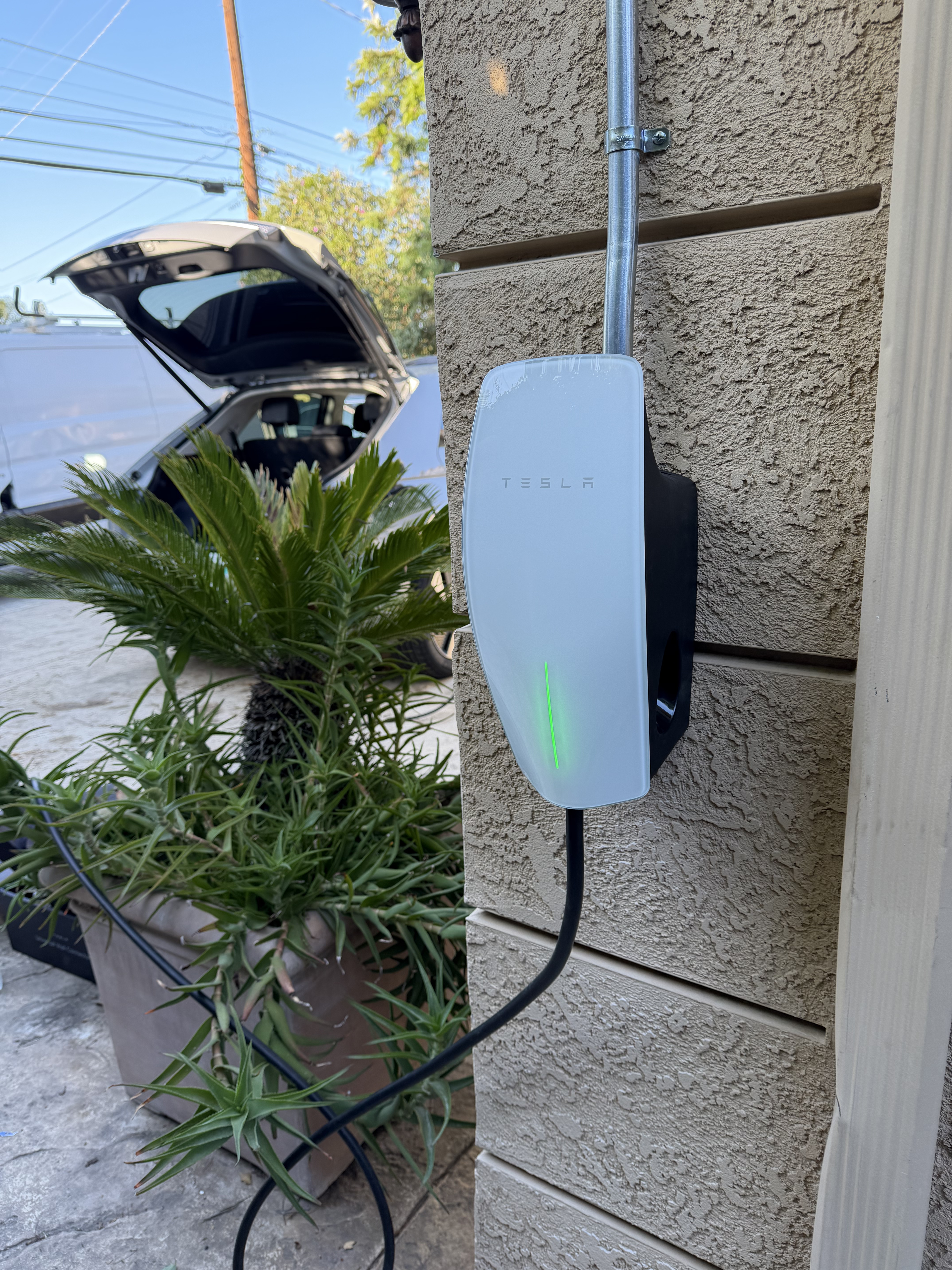
LED Guys is certified by Tesla Energy to install the Tesla Wall Connector and Universal Wall Connector to Tesla's own installation standards. That certification covers the full scope of a residential or commercial Wall Connector project: conductor sizing per NEC Article 625, dedicated circuit breaker selection, conduit and wire routing, GFCI breaker protection per NEC 625.54, and proper grounding and bonding at the panel.
After the physical installation, Jorge commissions the Wall Connector through the Tesla One app — connecting the unit to Wi-Fi, registering it to your Tesla account, setting the output amperage to match your circuit, and configuring access controls if you want to restrict charging to authorized vehicles. For multi-vehicle homes and commercial sites, we configure Power Sharing so up to six Wall Connectors intelligently share a single circuit without exceeding its capacity.
The Wall Connector delivers up to 48 amps on a 60-amp circuit, the fastest Level 2 charging Tesla offers for home use. Its built-in amperage adjustment (12, 16, 24, 32, 40, or 48 amps) means it works with any panel — from a 100-amp service with limited headroom to a 400-amp commercial main. Tesla's NACS connector is now the North American charging standard (SAE J3400), so the Wall Connector charges Teslas natively and other EV brands via adapter or native NACS port. The Universal Wall Connector adds a built-in J1772 connector for households with mixed EV brands.
Certified for Tesla Powerwall home battery installations — whole-home backup, Backup Gateway integration, solar coordination, and Charge on Solar setup so your Tesla charges from excess solar production automatically.
Powerwall installations include gateway wiring, backup circuit selection based on your household's critical loads, and utility interconnection paperwork for LADWP net metering. Jorge configures Storm Watch, self-consumption mode, and time-based control through the Tesla app so your system responds automatically to grid conditions and rate schedules.
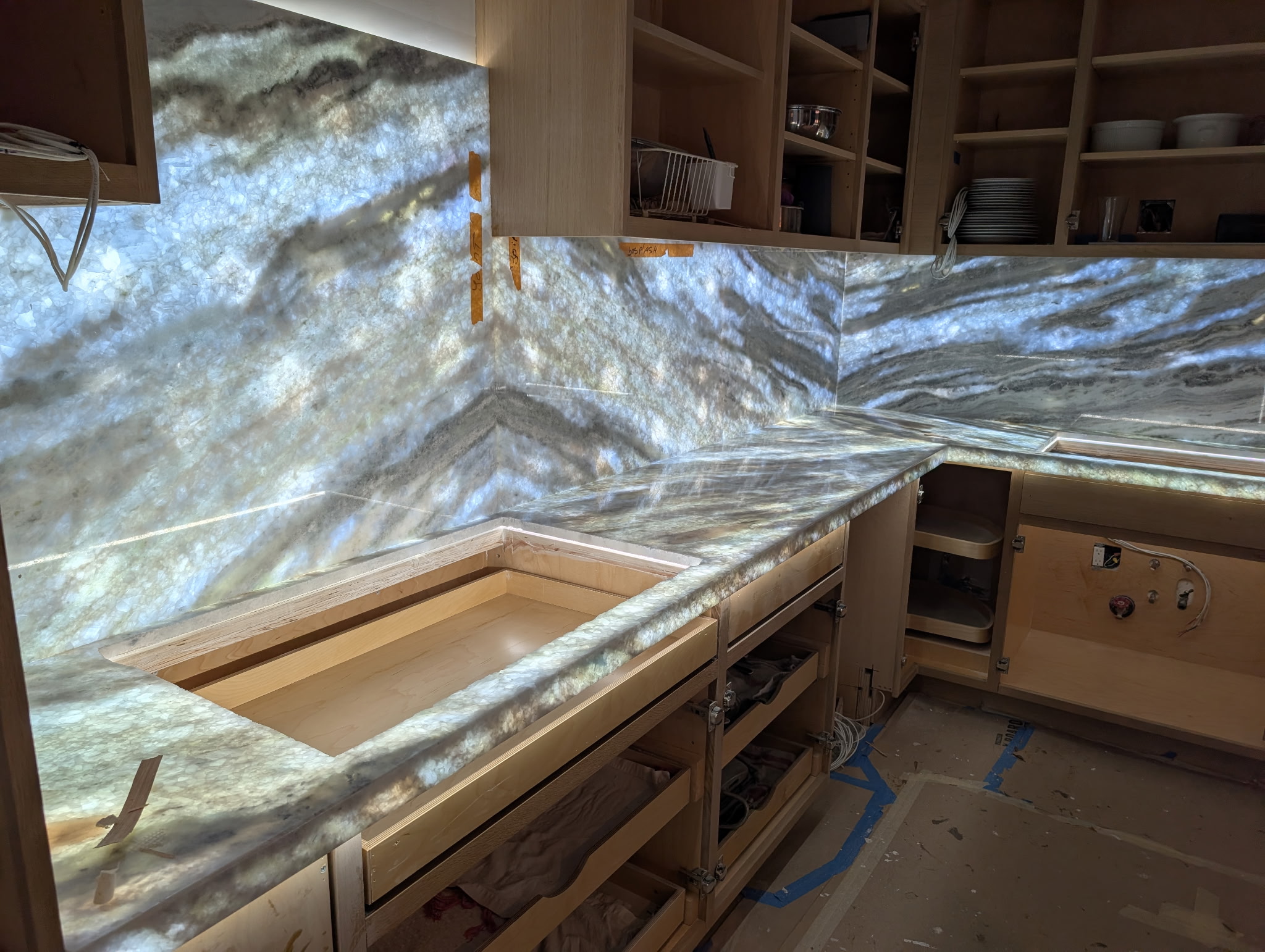
LED Guys is a GlowbackLED Trusted Lighting Installer — a designation earned by electrical contractors who consistently deliver high-quality installations of GlowbackLED's custom LED lighting systems. GlowbackLED is a US-based designer and manufacturer of architectural LED solutions: custom LED panels, recessed and pendant linear fixtures, LED aluminum channels, and cabinet lighting built to specification for high-end residential and commercial projects.
When a project calls for custom-fabricated LED lighting — a coffered ceiling with built-in linear channels, back-lit niches, under-cabinet strip lighting with dimmer controls, or a commercial lobby with signature pendant fixtures — Jorge sources components from GlowbackLED and installs them to their technical specifications. Every GlowbackLED installation includes proper driver placement, dimmer compatibility verification, and clean concealed wiring so the finished result matches the design intent.